
The Thermal Rhythm of the Dhauladhar
The Dhauladhar range rises abruptly from the Kangra Valley, its granite faces catching the early morning sun while the tea gardens below remain pooled in shadow. Here, at altitudes averaging 1,200 to 1,400 metres, the air behaves differently. Cold drafts descend from the snowline at night, settling over the tea estates of Palampur before the daytime sun warms the valley floor. It is this daily thermal shift that dictates the slow growth of the leaves, shaping the distinct character of the green and black teas produced here. Among these, the cultivation of kangra orthodox black tea single origin palampur stands out as a study in geographic specificity.
Unlike the high-yielding hybrid varieties common in other tea-growing territories, Palampur's gardens still rely on the original Camellia sinensis var. sinensis cultivars planted in the mid-nineteenth century. Dr. William Jameson, superintendent of the Botanical Gardens at Saharanpur, identified this terrain as ideal for Chinese tea plants in 1849. Today, these low-yielding, small-leaved bushes produce a liquor that is notably lighter and more aromatic than its eastern counterparts in Assam. The plants develop deep root systems to anchor in the rocky terrain, drawing minerals that contribute to the tea's clean finish.
The Neugal Influence and Silt-Rich Soils
The Neugal river gorge cuts a deep path near Palampur, channeling cool air directly into the tea gardens. This constant air movement prevents frost from settling on the young shoots during the cold transition from winter to spring. The soil here is deep, acidic, and well-drained, consisting primarily of clay loam and forest silt washed down from the higher ridges. This geological composition dictates the chemical makeup of the leaf, encouraging a higher concentration of natural catechins that emerge during brewing as a delicate, structural astringency.
The spring pluck begins in April, once the winter dormancy breaks and the first warm rains trigger new growth. Pluckers move through the rows, harvesting only the terminal bud and the two youngest leaves. This selection requires a precision that automated harvesting cannot replicate; the stems must be snapped cleanly to prevent bruising before the leaf reaches the factory. Hand-plucking ensures that only leaves of uniform maturity enter the processing cycle, which is essential for an even oxidation process.
The Mechanics of Orthodox Processing
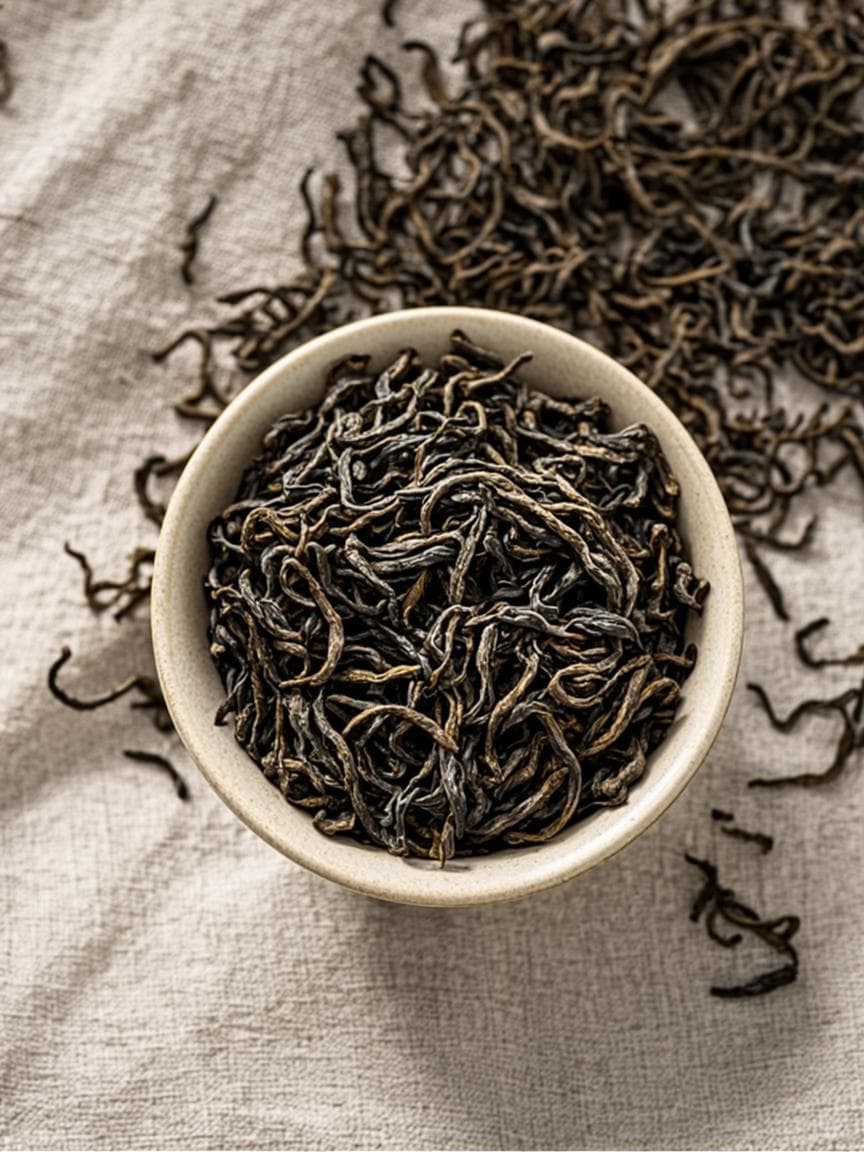
Once inside the factory, the process relies entirely on the orthodox method, where preserving the physical integrity of the leaf is paramount. The freshly plucked leaves are spread across raised withering troughs, where large fans pass ambient air through them for up to twenty hours. This slow dehydration reduces the moisture content by half, rendering the leaves pliable enough for the rolling tables. Here, gentle mechanical pressure mimics the circular hand-rolling of earlier eras, bruising the cell walls without tearing the leaf. This controlled bruising initiates oxidation, a chemical transformation where enzymes convert catechins into thearubigins and theaflavins, giving the tea its characteristic amber hue and complex body.
The final stage of drying stops this oxidation at a precise moment. In Palampur, the resulting tea is defined by a subtle, pale liquor. While many black teas offer a heavy, tannic astringency, this orthodox preparation yields a cup that is notably smooth, marked by distinct notes of malt and dried dark fruits. The finish is clean, leaving a faint sweetness on the back of the palate rather than a drying sensation.
Preparing a cup of this single-origin tea requires a similar measure of restraint. Water brought to 90 degrees Celsius—just short of a rolling boil—prevents the delicate leaves from scalding. A three-minute steep allows the tightly rolled leaves to unfurl completely, releasing their character gradually without releasing excess bitterness. It is a drink shaped entirely by the geography of the valley and the deliberate pace of its production.
kangra orthodox black tea single origin palampur
Key Takeaways
- Kangra orthodox black tea from Palampur is cultivated at altitudes of 1,200 to 1,400 metres, where the unique thermal rhythm of the Dhauladhar range slows leaf growth.
- Unlike high-yielding hybrid varieties, these Palampur estates still rely on original mid-nineteenth-century China tea cultivars that produce a lighter, highly aromatic liquor.
- The tea is harvested entirely by hand in a spring pluck starting in April, selecting only the terminal bud and the two youngest leaves to prevent bruising.
- Processed using traditional orthodox methods, the final tea is smooth and amber-hued, offering distinct notes of malt and dried dark fruits with a clean finish.
FAQs
How should this delicate black tea be stored to preserve its volatile aromas?
Keep the loose leaves in an airtight, opaque container away from direct sunlight, moisture, and strong kitchen spices. Because orthodox black teas are fully oxidized, they remain highly stable and will retain their nuanced flavor profile for up to two years when stored in a cool, dark cupboard.
What caused the historical decline and subsequent revival of Kangra's tea estates?
A catastrophic earthquake in 1905 devastated the region, destroying local factories and prompting many British planters to abandon their estates. The industry survived when local Himachali families took over the small-holder plots, preserving the original nineteenth-century heirloom bushes through generations of artisanal farming.
What is the recommended leaf-to-water ratio for brewing a balanced cup of Palampur black tea?
Using two grams of loose leaves—roughly one rounded teaspoon—per 150 milliliters of filtered water yields the cleanest extraction. A porcelain or glass teapot is ideal for this, as it does not retain excessive heat that might otherwise over-extract the delicate spring leaves.
How do the harvests later in the year compare to the primary spring pluck?
While the spring harvest yields the lightest and most floral liquor, the subsequent monsoon and autumn flushes offer a deeper, more robust character. These later-season leaves endure more intense sunlight, resulting in a darker cup with more pronounced woody and sweet notes that contrast with the delicate April harvest.
Should milk or sweeteners be added to Kangra orthodox black tea?
Purists recommend drinking this single-origin tea entirely plain. Unlike robust, CTC-grade black teas from other Indian regions, the delicate, aromatic profile of original China-cultivar leaves is easily overwhelmed by dairy or sugar, which masks the natural malt and dried fruit notes.


